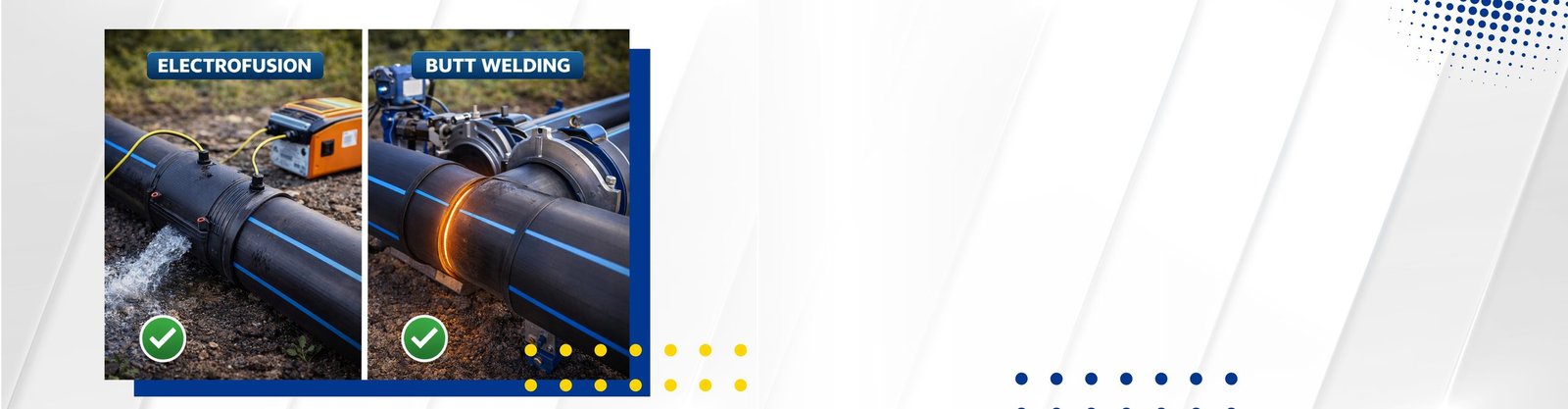
When installing HDPE pipes for water supply, gas distribution, irrigation, or industrial applications, proper jointing is critical. Even the highest-quality pipe can fail if joints are poorly executed. Two of the most widely used methods for joining HDPE pipes are electrofusion welding and butt welding. Understanding the differences, advantages, and best practices for each method ensures strong, leak-proof, and long-lasting pipeline systems.
What Is Electrofusion Welding?
Electrofusion welding is a method that uses specially designed fittings embedded with electrical heating coils. During installation, an electrofusion machine supplies controlled electrical current to the fitting, causing the coils to heat up and melt both the outer surface of the pipe and the inner surface of the fitting. Once the material cools, it forms a strong, uniform bond. This method is particularly useful in tight or confined spaces where pipe movement is limited. Electrofusion is commonly applied in urban water networks, gas distribution lines, and repair works because it allows for precise and reliable connections with minimal pipe alignment challenges.
What Is Butt Welding?
Butt welding, also known as butt fusion, involves heating the ends of two HDPE pipes using a heating plate and then pressing them together under controlled pressure. After the molten ends are fused and allowed to cool, the joint becomes as strong as — or sometimes stronger than — the pipe itself. Butt welding does not require additional fittings, making it cost-effective for long pipeline runs. It is widely used in large-scale HDPE water pipe projects, including municipal water distribution systems and industrial installations where open site access allows for proper alignment and clamping.
What Are the Key Differences Between Electrofusion and Butt Welding?
The main difference between electrofusion and butt welding lies in application flexibility and cost efficiency. Electrofusion requires specialized fittings and is better suited for repair works, confined spaces, and complex installations. Butt welding, on the other hand, is more economical for long-distance pipelines and large-diameter pipes because it eliminates the need for additional fittings. While both methods create strong, leak-proof joints, the choice depends on project size, site accessibility, budget considerations, and technical requirements.
What Are the Best Practices for HDPE Pipe Jointing?
Regardless of the method used, proper installation procedures must be followed to ensure joint integrity. Surface preparation is essential, as pipe ends must be clean, dry, and free from contaminants before welding. For electrofusion, scraping the pipe surface ensures optimal bonding. Proper alignment is equally important, as misaligned pipes can weaken the joint structure. Temperature control during heating must be precise to avoid under-fusion or overheating, both of which compromise joint strength. In butt welding, maintaining correct fusion pressure and allowing adequate cooling time are critical steps before pressurizing the system. Most importantly, only trained and experienced technicians should perform HDPE welding to ensure compliance with safety and performance standards.
Why Should You Use Certified HDPE Pipes?
Even the most advanced welding techniques cannot compensate for poor-quality materials. HDPE pipes should meet regulatory standards to ensure compatibility with fusion methods and long-term durability. Manufacturers approved by the Standard Organisation of Nigeria provide pipes that undergo pressure testing, dimensional checks, and impact resistance evaluations. Using certified products reduces the risk of joint failure and ensures compliance with project specifications, especially in government and large-scale infrastructure projects.
Who Is a Reliable HDPE Pipe Manufacturer in Nigeria?
Selecting the right supplier is just as important as selecting the right welding method. Cobef International Limited manufactures high-quality HDPE pipes suitable for both electrofusion and butt welding applications. With a modern manufacturing facility in Port Harcourt, the company supplies contractors, oil and gas installations, agricultural projects, and municipal water infrastructure across Nigeria. For businesses searching for HDPE pipe suppliers Nigeria, HDPE pipe welding solutions Nigeria, or certified HDPE water pipes Port Harcourt, partnering with an established manufacturer ensures consistent quality and reliable bulk supply.
Head Office:
Km 17 Port Harcourt/Aba Express Way
Port Harcourt, Rivers State, Nigeria
Phone:
+234 (0)813 576 3467
+234 (0)811 734 4533
+234 (0)902 149 3237
Email:
pawan.tekchandani@cobefinternationalltd.com
cobefinternationallimited@gmail.com
